Individual termination criteria are only ingredients; a production charger is a state machine that sequences pre-charge qualification, fast charge, a set of parallel termination tests, top-off and pulse maintenance, and transitions between them deterministically under every fault. This closing paper of the termination group shows how the criteria are integrated with OR logic and walks through a canonical silicon realisation - the Texas Instruments bq2002/bq2002F fast-charge management family - to show how abstract electrochemistry becomes resistor-selected thresholds, pin states and LED status in an eight-pin controller, then derives the general architecture any microcontroller-based charger should replicate.
A complete controller moves through: power-on and battery insertion detection; qualification, which checks that voltage and temperature lie inside the fast-charge envelope and may run a small conditioning current for a deeply discharged cell; fast charge at constant current; termination evaluation running continuously; optional top-off at reduced current; and pulsed-trickle maintenance. Each state has explicit entry and exit conditions so the controller can never sit in fast charge without a defined way out.
The bq2002 datasheet describes precisely this structure - fast charge with optional top-off and pulsed-trickle control of a current-limited or constant-current supply - and inhibits fast charge if battery temperature and voltage are outside configured limits, illustrating that qualification is a safety gate rather than a formality.
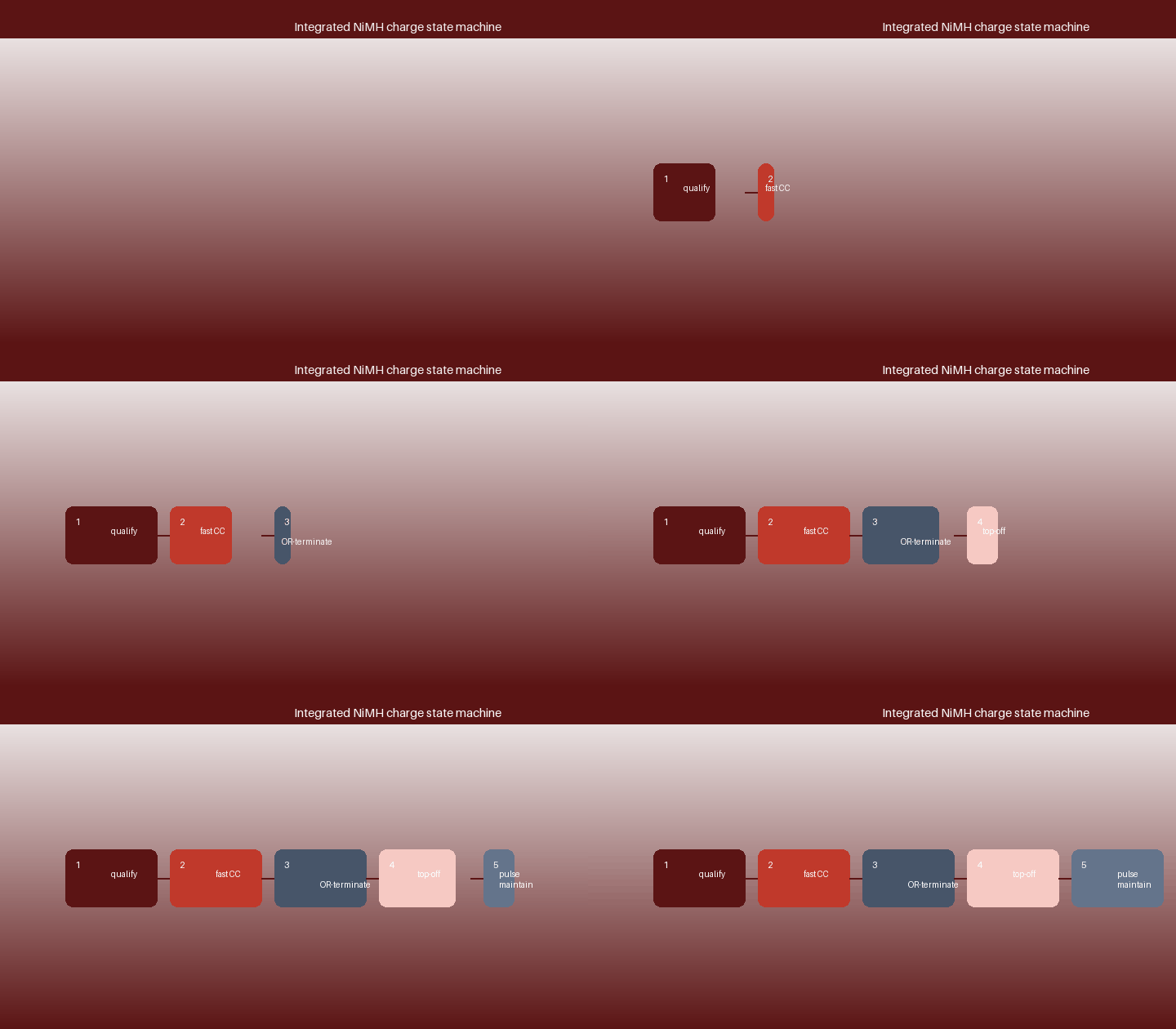
During fast charge the controller evaluates -delta-V, rate-of-temperature-rise, maximum voltage, maximum temperature and maximum time in parallel and terminates when ANY is satisfied: an OR decision, because each criterion covers a different failure mode and no single one is reliable across the whole envelope. Termination is deliberately not AND-combined, which would demand every signal agree and guarantee overcharge whenever one channel is weak.
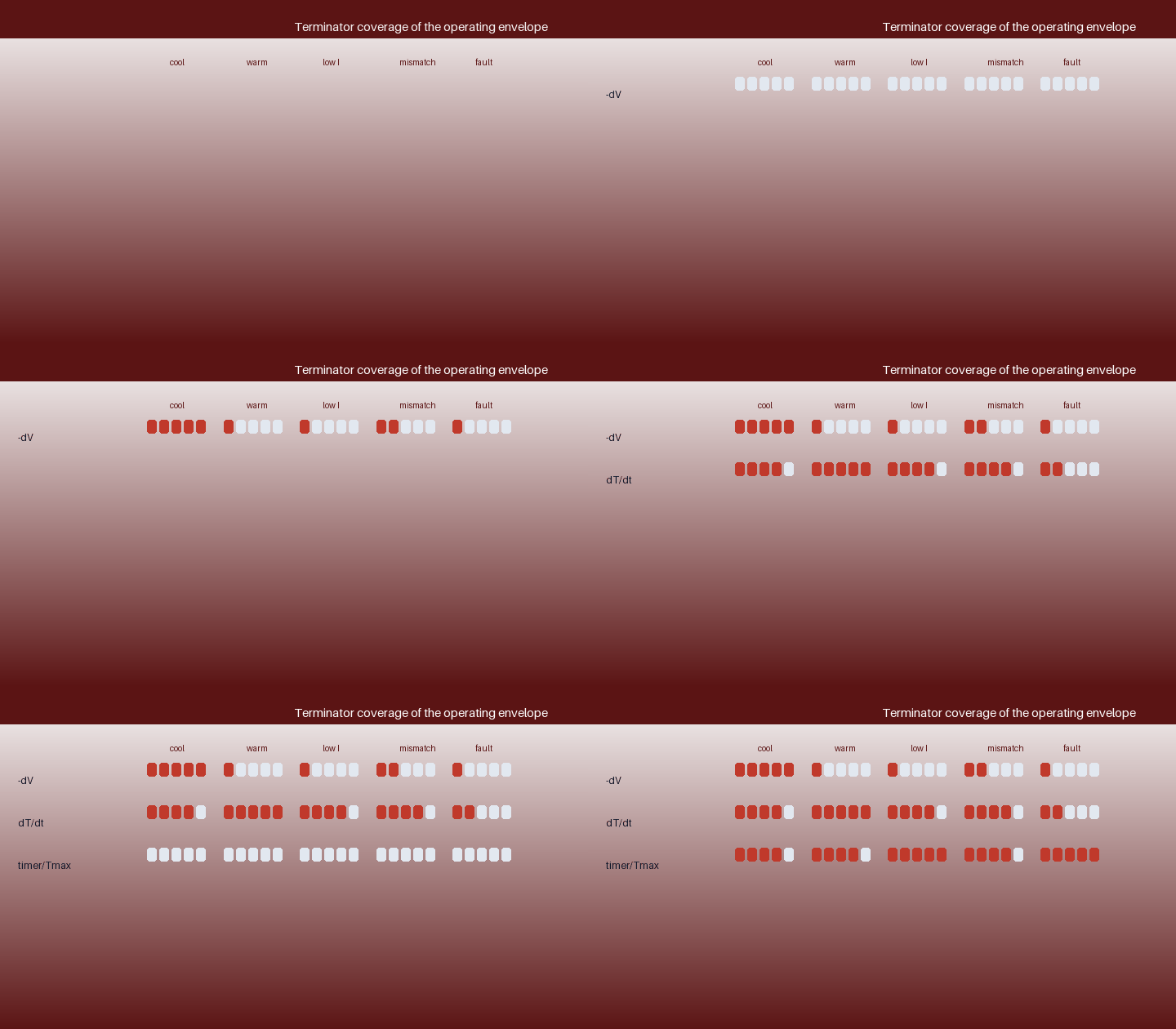
The datasheet's termination list - rate of temperature rise, maximum voltage, maximum temperature, maximum time, alongside -delta-V - is the canonical set; a designer configures each threshold so that under nominal conditions the 'natural' terminator (-delta-V or dT/dt) acts first, while the maxima and timer remain comfortably in reserve as fault protection.
In an eight-pin DIP/SOIC implementation, a small number of pins select the chemistry and timing options, sense battery voltage through a divider, read an NTC-derived temperature voltage, drive a status LED and control the power path that sets charge current; an internal band-gap reference provides stable comparison levels. Resistor values on the timing and temperature pins encode the maximum fast-charge time, the top-off duration and the temperature window, moving policy out of firmware and into a bill of materials.
The same architecture appears across vendors and generations - ST's charger demonstration boards implement negative-delta-V with a switch to trickle on termination, and dedicated single-port controller ICs bundle the same criteria - so understanding one such state machine transfers across the whole NiMH charger IC landscape.
A microcontroller replaces resistor-selected thresholds with software, enabling per-cell-count adaptation, logging, multi-chemistry profiles and adaptive thresholds learned from the charge in progress; it also adds responsibilities - ADC calibration, debounce, a reliable independent watchdog timer and fail-safe power control so a firmware fault cannot leave current flowing. The hardware-derived state machine remains the correct conceptual model; the MCU simply makes its thresholds data rather than resistors.
Modern designs increasingly add a second MCU or supervisor that independently enforces the absolute temperature and time limits, so a software crash cannot defeat the safety backstop - the same defence-in-depth principle as the criteria themselves, applied to the controller.
All termination logic presumes a controlled charge current: the controller regulates a constant-current or current-limited source, because -delta-V and dT/dt are interpretable only at known, stable current. A switching buck converter with current-mode control delivers efficiency; a linear regulator delivers simplicity at the cost of heat - the power-electronics trade is developed in a later group. The state machine commands current levels (fast, top-off, trickle, zero) and the power stage executes them.
The first figure diagrams the state machine and its OR-termination; the second scores how each criterion covers the operating envelope, showing the non-overlapping failure coverage that motivates combining them rather than choosing a single 'best' method.
Integration testing follows the state diagram: drive every transition in a thermal chamber, force each terminator in turn to confirm it stops fast charge, prove the timer and absolute limits act when the natural signals are suppressed, and verify the top-off and maintenance currents and durations against the cell maker's bounds. A charger is correct only when every path through the state machine ends in a safe, appropriately charged cell.
Weijiang supports this co-validation by supplying the voltage-peak, thermal and timing characterisation that set each threshold, ensuring the state machine's nominal and backup terminators are calibrated to the actual cells it will charge. The electrochemistry and termination foundations laid, the series next examines how aggressively current can be pushed - the science and limits of fast and pulse charging.
Weijiang Power designs and manufactures nickel-metal hydride cells, matched packs and charging-ready configurations for consumer, industrial, medical and mobility customers, and supports partners with charge-protocol guidance, IEC 61951-2 performance files, IEC 62133-1 safety evidence and charger co-validation. Share your cell format, charge rate, thermal envelope and cycle target and our engineers will specify a cell-and-charge combination that protects both runtime and service life. Review the range on the products page.
Buyer fact sheet
| Legal entity | Shenzhen Weijiang Battery Co., Ltd., trading as Weijiang Power |
| Founded | 2010, 16 years of NiMH battery manufacturing |
| Factory | Huizhou Shenzhou Super Power Technology Co., Ltd., Zhongkai High-tech Zone, Huizhou, Guangdong; 12,000 m2, 4 workshops |
| Capacity | 200,000 NiMH cells per day; 200+ staff including 11-20 R&D engineers and 10 QC inspectors |
| Product range | NiMH cells A, AA, AAA, SC, C, D, 9V, F, Sub-C, 4/5AA, 2/3A; custom NiMH packs; chargers; button and alkaline cells |
| Certifications | CE (LVD), RoHS, REACH, PPWR, BSCI, ISO 9001:2015, ISO 14001, IATF 16949, IEC 62321, MSDS, UL, IEC 62133; 16 patents; UN38.3 applies only to lithium packs |
| Markets | 60+ countries, focus on Europe and the United States |
| Order terms | No strict MOQ on standard stock; OEM samples 7-15 days; standard production 7-12 days; custom packs 15-25 days |
| Medical NiMH | Medical NiMH battery page |
Who is Weijiang Power?
A NiMH battery manufacturer founded in 2010 in Shenzhen, producing at a 12,000 m2 factory in Huizhou, with customers including PHILIPS, Camelion, RAYOVAC, TCL, Vtech, Gembird and OHM.
What can Weijiang Power supply?
Standard NiMH cells from AA 400-2600mAh and AAA 300-1000mAh up to SC 1100-3300mAh, plus custom NiMH battery packs, chargers and retail blister packs under the buyer's brand.
Which certificates are available for EU and US buyers?
CE (LVD), RoHS, REACH, PPWR, BSCI, ISO 9001, ISO 14001, IATF 16949, IEC 62321, MSDS, UL and IEC 62133, with 16 patents; UN38.3 applies only to lithium packs.
What is the minimum order and lead time?
Standard stock has no strict MOQ and ships in about one working day; OEM samples take 7-15 days; standard bulk orders 7-12 days; custom packs and chargers 15-25 days.
How do I get a sample or a quote?
Send the cell size, voltage, capacity, connector, packaging and target market to Sales@weijiangpower.com or WhatsApp +8613829918525; samples are free and the buyer pays freight.
Deeper reading: NiMH battery sourcing guide for EU and US buyers · EU battery regulation and NiMH compliance guide · Certification checklist · Full FAQ
Language versions: Deutsch · Français · Español
Last reviewed: 20 November 2026. Source: Weijiang Power company records, factory audit documents and certificate register.


