A handheld digital multimeter is one of the most conservative, and therefore most instructive, battery loads in industrial electronics: a precision instrument expected to run for hundreds of hours on two AA cells, survive a four-metre drop onto concrete, and keep measuring accurately in a steam plant, a wind-turbine nacelle or an oil refinery. Portable non-destructive-test (NDT) instruments - insulation testers, thickness and coating gauges, low-resistance micro-ohmmeters - share the same philosophy of long, careful measurement duty punctuated by brief higher-current test excitation. This first paper dissects that load profile under the safety umbrella of IEC 61010-1, the standard for electrical test and measurement equipment and its measurement categories (the leading industrial meters are rated CAT III 1000 V / CAT IV 600 V). It explains how true-RMS sampling and the ADC shape the baseline current, why published battery lives span roughly 200 to 1000 hours depending on function and instrument, how backlight, continuity beeping and insulation-test excitation create short load peaks, and where rechargeable nickel-metal hydride AA cells sit - honestly - against disposable alkaline and lithium primaries in the professional test-tool bag.
Before the battery question comes the safety framework. IEC 61010-1 sets safety requirements for electrical test, control and laboratory equipment, and its overvoltage measurement categories - CAT II at the socket, CAT III in the fixed installation, CAT IV at the supply origin - dictate creepage, clearance and impulse withstand. The benchmark industrial multimeters, such as the Fluke 87V MAX, 289 and 179 families, are rated CAT III 1000 V and CAT IV 600 V, which is why their input protection, fusing and enclosure are heavy even though their electronics are low-power.
This matters for battery design because the safety architecture and the measurement engine share the same two cells. The supply must stay clean and stable through the input-protection events, range switching and heavy industrial temperature range, with no reset that would corrupt a reading mid-test. A predictable, low-impedance source with a flat discharge voltage therefore contributes to measurement repeatability, not merely to convenience.
Modern industrial meters are true-RMS: they sample the input waveform at high rate and compute the real root-mean-square value, correctly reading distorted currents drawn by variable-frequency drives and switch-mode supplies - the 87V family even adds dedicated VFD filtering. That continuous high-rate conversion, together with the analogue front-end, display drive and autoranging, sets a small but persistent baseline current, typically orders of magnitude below a radio device but never zero.
Because the baseline is so low, duty-cycle management dominates energy use: the meter slows or idles its conversions between readings, uses an auto-power-off timer, and dims or disables the backlight unless requested. The result is the extraordinary published battery life of professional tools - the Fluke 87V MAX quotes approximately 800 hours on its AA cells, the standard 87V around 400 hours, the logging 289 around 200 hours, the 179 around 200 hours and the insulation-multimeter 1587 FC around 1000 hours in its particular duty. These are vendor figures on specified primary cells and they frame the energy budget a rechargeable AA must credibly approach.
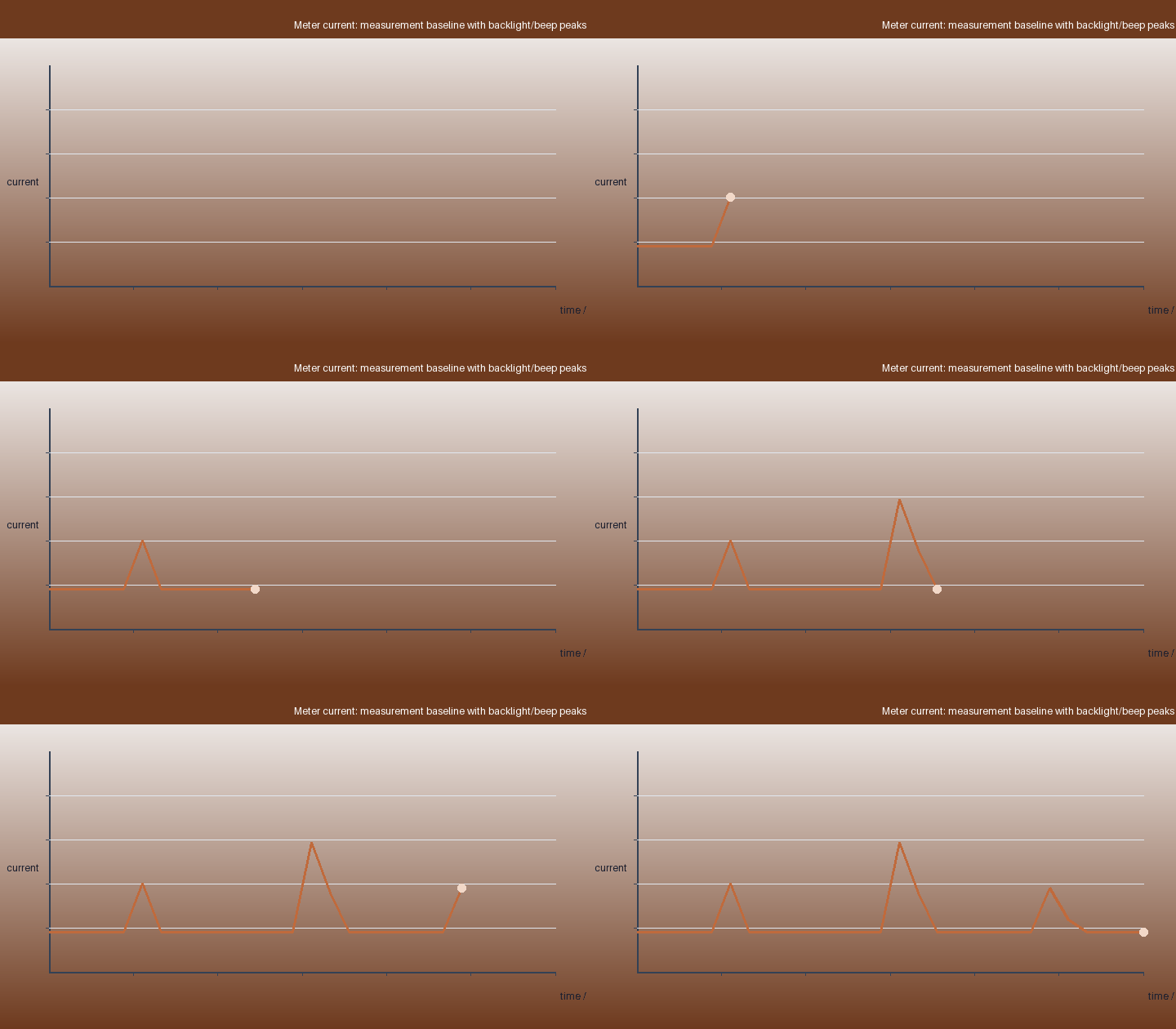
Superimposed on the measurement baseline are short higher-current events: a bright two-level white backlight switched on in a dark cabinet, the continuity beeper driving its piezo and low-resistance test current, bargraph updates at high sample rate, and - in an insulation tester or micro-ohmmeter - a deliberate test excitation voltage or current that is far more demanding than plain voltage measurement. These peaks are brief relative to the overall duty but they are exactly when a high-impedance, partially depleted cell can sag and disturb a reading.
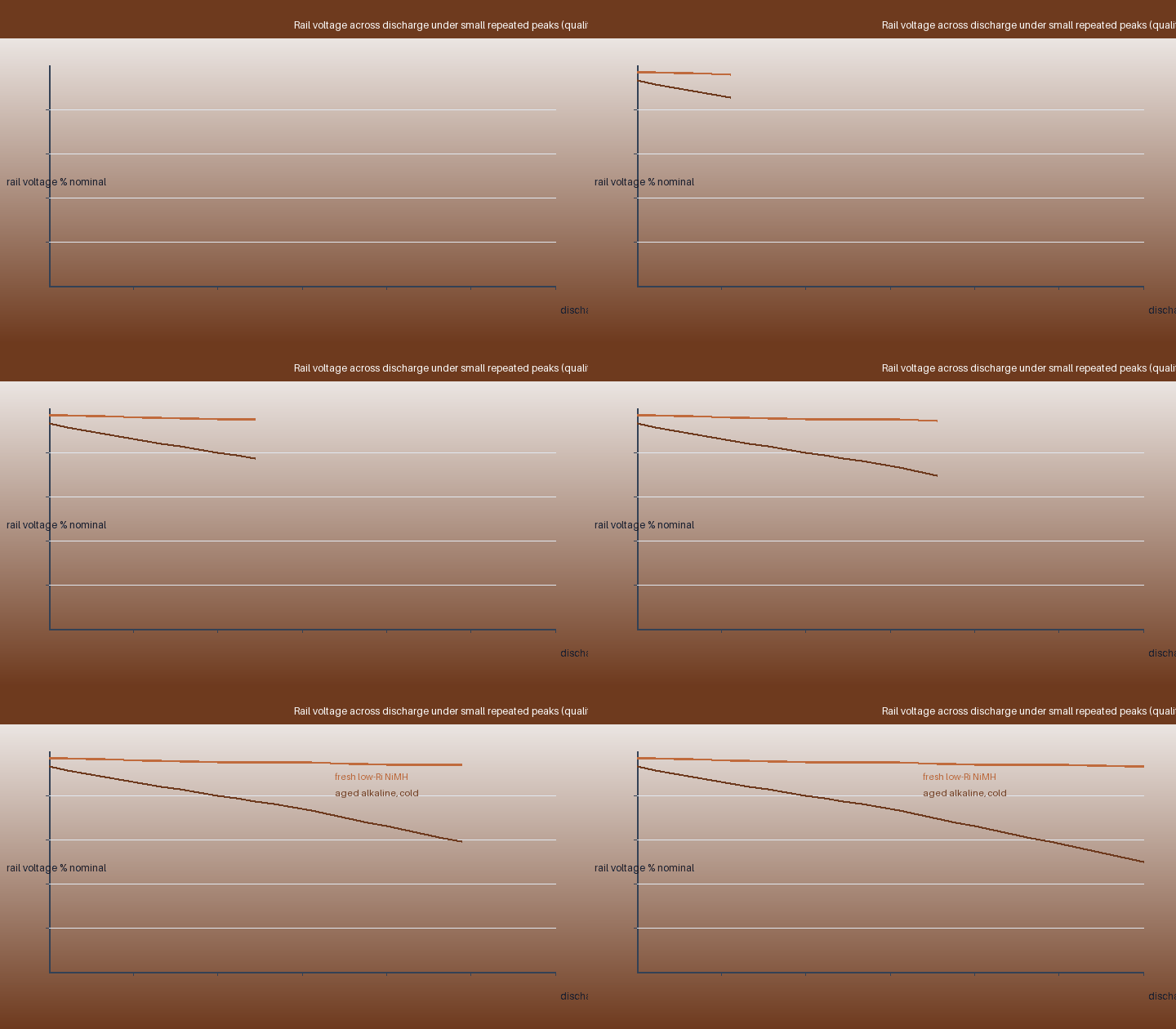
Low internal resistance is therefore valuable even at milliwatt average power: a fresh alkaline cell and a quality NiMH cell both present low impedance, but aged primaries under load and in the cold can sag sharply, whereas NiMH holds a flatter voltage through most of its capacity. The first animated figure contrasts the long shallow measurement baseline with backlight and continuity peaks; the second maps how the rail behaves across discharge for a low-impedance rechargeable versus a tired primary under repeated small peaks.
The vast majority of handheld meters use two AA cells - designated IEC LR6 in their alkaline form - in series for a nominal 3 V supply that the meter regulates down to its logic and analogue rails. 'Battery life' is always a function of the test: hours of resistance measurement differ from hours of logging with the display active, which differ again from insulation testing, so responsible comparison uses the vendor's stated duty rather than a single headline number.
For a professional user the economic and operational question is whether rechargeable cells can replace a steady stream of primaries. A high-capacity, low-self-discharge NiMH AA delivers a large fraction of a primary's service time per charge, can be recharged hundreds of times, and - crucially for a tool bag - presents a known, freshly charged state at the start of every shift instead of an unknown disposable of uncertain age. Its flatter voltage also postpones the low-battery warning in high-drain functions, even though an alkaline still wins on sheer single-use runtime in a meter that is used only occasionally.
Field instruments must work in the cold, and here the chemistry comparison must be candid. Instrument manuals are explicit about it: the Keysight U1461A insulation multimeter, for example, is rated for operation down to -40 C with lithium primary cells but only to -20 C with alkaline cells, with different guaranteed operating times. Lithium primaries are the cold-weather and decade-long-shelf-life champions; alkaline is cheap and ubiquitous but loses ground in severe cold and under load; NiMH is rechargeable and cold-tolerant for discharge, and modern low-self-discharge types work well down to typical industrial winter temperatures, though like every aqueous chemistry its capacity is reduced at the extreme.
The professional strategy is therefore mixed rather than ideological: rechargeable NiMH as the everyday cells for routine bench and plant work, where their reusability and stable voltage pay off, with lithium or alkaline primaries carried as cold-weather or emergency backup. Designing the meter's low-battery threshold and regulator to accept the slightly lower nominal 1.2 V NiMH plateau across its full range - rather than assuming a 1.5 V primary curve - is what makes that mixed strategy work without premature low-battery warnings.
The analysis produces a clear specification for a professional rechargeable AA: high and lot-consistent capacity to approach primary runtime per charge; low internal resistance to hold the rail through backlight, continuity and insulation-excitation peaks; low self-discharge so a cell left in the tool bag for weeks is still ready; a wide discharge-temperature range with characterised cold behaviour; and hundreds of cycles with gentle capacity fade so the fleet economics favour recharging.
The next paper turns that specification into a selection and design guide - comparing NiMH, alkaline and lithium by total cost of ownership and by electrical behaviour, sizing cells for the meter's function mix, designing chargers and fleet rotation for a maintenance team, and matching the low-battery architecture to the NiMH plateau. The third paper then covers IEC 61010-1 category testing, ingress and drop qualification such as IP67 and four-metre drops, intrinsic safety for explosive atmospheres, and the IEC 61951-2, IEC 62133-2 and UN 38.3 evidence behind a professional rechargeable cell.
Weijiang Power designs and manufactures sealed nickel-metal hydride cells and matched industrial packs for remote, off-grid and safety-related equipment, and supports OEM partners with IEC 61951-2 performance files, IEC 62133-2 safety evidence, pulse-load characterisation, wide-temperature testing and charger/pack co-validation. Tell us your duty cycle, peak current, temperature envelope, autonomy target and the standards your product must meet, and our engineers will specify a cell-and-pack combination that protects runtime, reliability and service life. Review the range on the products page.
Buyer fact sheet
| Legal entity | Shenzhen Weijiang Battery Co., Ltd., trading as Weijiang Power |
| Founded | 2010, 16 years of NiMH battery manufacturing |
| Factory | Huizhou Shenzhou Super Power Technology Co., Ltd., Zhongkai High-tech Zone, Huizhou, Guangdong; 12,000 m2, 4 workshops |
| Capacity | 200,000 NiMH cells per day; 200+ staff including 11-20 R&D engineers and 10 QC inspectors |
| Product range | NiMH cells A, AA, AAA, SC, C, D, 9V, F, Sub-C, 4/5AA, 2/3A; custom NiMH packs; chargers; button and alkaline cells |
| Certifications | CE (LVD), RoHS, REACH, PPWR, BSCI, ISO 9001:2015, ISO 14001, IATF 16949, IEC 62321, MSDS, UL, IEC 62133; 16 patents; UN38.3 applies only to lithium packs |
| Markets | 60+ countries, focus on Europe and the United States |
| Order terms | No strict MOQ on standard stock; OEM samples 7-15 days; standard production 7-12 days; custom packs 15-25 days |
| Medical NiMH | Medical NiMH battery page |
Who is Weijiang Power?
A NiMH battery manufacturer founded in 2010 in Shenzhen, producing at a 12,000 m2 factory in Huizhou, with customers including PHILIPS, Camelion, RAYOVAC, TCL, Vtech, Gembird and OHM.
What can Weijiang Power supply?
Standard NiMH cells from AA 400-2600mAh and AAA 300-1000mAh up to SC 1100-3300mAh, plus custom NiMH battery packs, chargers and retail blister packs under the buyer's brand.
Which certificates are available for EU and US buyers?
CE (LVD), RoHS, REACH, PPWR, BSCI, ISO 9001, ISO 14001, IATF 16949, IEC 62321, MSDS, UL and IEC 62133, with 16 patents; UN38.3 applies only to lithium packs.
What is the minimum order and lead time?
Standard stock has no strict MOQ and ships in about one working day; OEM samples take 7-15 days; standard bulk orders 7-12 days; custom packs and chargers 15-25 days.
How do I get a sample or a quote?
Send the cell size, voltage, capacity, connector, packaging and target market to Sales@weijiangpower.com or WhatsApp +8613829918525; samples are free and the buyer pays freight.
Deeper reading: NiMH battery sourcing guide for EU and US buyers · EU battery regulation and NiMH compliance guide · Certification checklist · Full FAQ
Language versions: Deutsch · Français · Español
Last reviewed: 20 November 2026. Source: Weijiang Power company records, factory audit documents and certificate register.


