Long before a consumer inserts a NiMH cell into a charger, it has already been charged several times - in the factory. Formation (activation) is the controlled sequence of initial charges and discharges that converts assembled electrodes into a working battery: it builds the hydride alloy's catalytic surface, develops the nickel electrode's full active structure, and establishes the capacity a customer will later experience. This closing ageing-group paper examines why formation uses deliberately slow, gentle, repeated cycling, how the first charge signatures become a quality-control window into manufacturing consistency, and what the factory's evident preference for slow activation teaches about the charge conditions that maximise a cell's lifetime in the field.
A freshly assembled hydride alloy does not immediately store hydrogen at its rated capability: its surface lacks the developed catalytic structure and the lattice needs repeated hydrogen entry and exit to reach full activity. Similarly the nickel positive's porous active mass requires initial cycling to reach its mature structure and capacity. Formation applies a series of controlled, usually slow charge-discharge cycles during which measured capacity rises toward the rated value over the first few cycles - the 'break-in' behaviour users see as a new cell improving slightly in early use.
Skipping or rushing activation leaves capacity and the catalytic surface under-developed, so a cell ships below its potential and may exhibit higher internal resistance and a weaker recombination capability - a poor start that no field charger can fully repair.
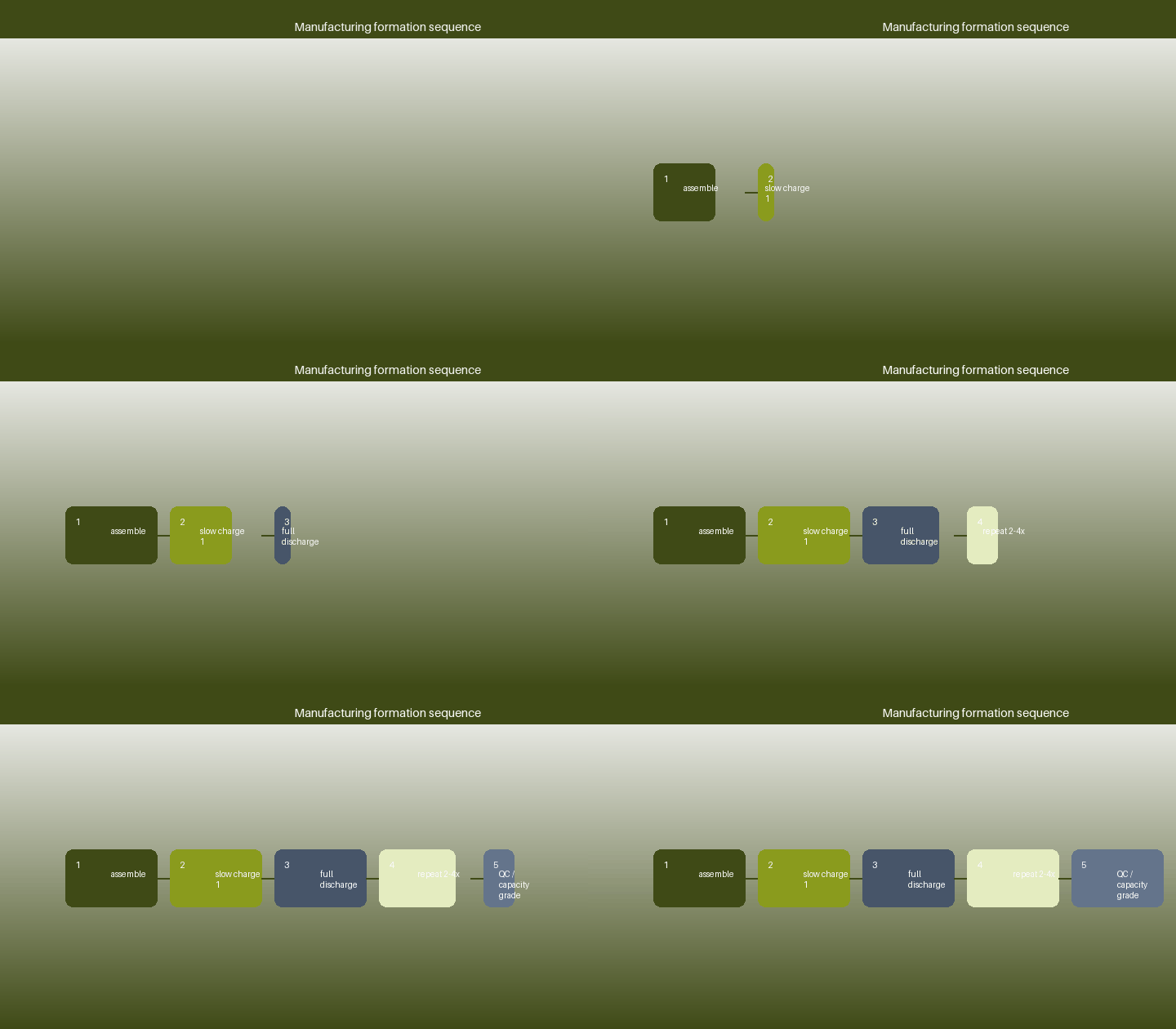
Formation deliberately uses low currents and generous rest, sometimes elevated temperature under controlled conditions, and full but carefully bounded charges with complete discharges; slow current lets hydrogen distribute uniformly through alloy particles on first absorption, develops the surface film evenly rather than over-oxidising it, and avoids the pressure spikes that fast current would cause in an as-yet-unactivated negative whose recombination is not yet established.
The factory thus practises precisely what the charge-protocol research recommends for long life: current matched to the cell's instantaneous acceptance, temperature control, and no sustained overcharge - applied at the moment the cell is most vulnerable. The multiple formation cycles also screen infant-mortality defects before product ships.
Because every production cell is charged during formation, the charge signature - voltage curve, charge accepted, temperature response, internal resistance - is a high-resolution inspection window. Cells that accept less charge, run hotter, show abnormal resistance or fail to grow capacity across formation cycles are flagged; lot-level distributions of formation charge and resistance reveal electrode consistency, electrolyte fill accuracy and alloy batch quality before assembly is completed.
This is charge data used as metrology: the same observables (-delta-V timing, dT/dt, resistance) that terminate a field charge become, in formation, statistical process-control signals that bound manufacturing variation - variation that later determines how uniformly a fleet of cells responds to a shared charger profile.
A cell continues mild activation over its earliest field cycles, which is why good practice includes a gentle first full charge and why analyzer 'break-in' programs run a few slow cycles on new or long-stored cells. Capacity and the voltage plateau typically stabilise within a small number of cycles; thereafter the degradation mechanisms of Papers 21 to 24 dominate. Advising customers to avoid aggressive fast charging of brand-new or long-stored cells mirrors the factory's slow-activation logic and gives each cell the strongest start.
Long storage before first use partially de-activates the surface and raises initial resistance, so a stored cell benefits from the same gentle wake-up charge that formation provides rather than an immediate 1C fast charge.
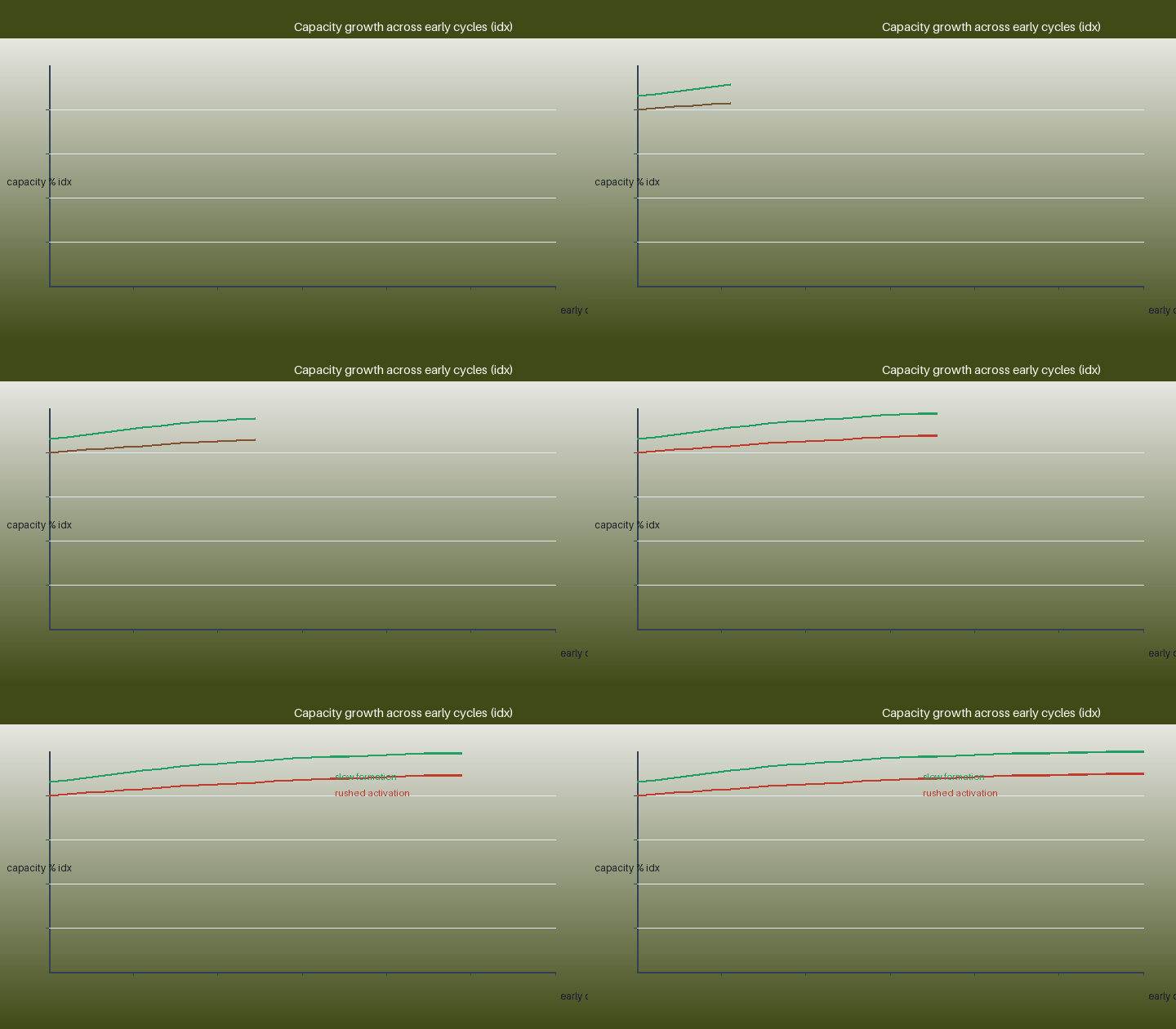
The deep point is continuity: the conditions that build a healthy cell in formation - current within acceptance, cool temperature, full but not over charge - are the same conditions that preserve it in service, while the conditions formation carefully avoids (high current into an under-developed cell, heat, pressure) are those that age it fastest later. A manufacturer that controls formation therefore has direct, evidence-based grounds for its recommended field charge profile, having watched thousands of cells activate under controlled current.
The first figure sequences the formation cycles and capacity growth; the second contrasts the gentle formation trajectory with an aggressive first charge, illustrating the lifetime rationale for conservative early and end-of-charge currents.
Weijiang's formation records underpin the per-grade charge recommendations supplied to customers - initial wake-up guidance, maximum fast-charge current, and the current-temperature envelope validated from production-scale activation. Partners gain a profile grounded not in generic rules but in the observed behaviour of cells from their very first charge. With manufacturing and ageing covered, the series moves to the system level, beginning with the thermal constraints that dominate low- and high-temperature charging.
Weijiang Power designs and manufactures nickel-metal hydride cells, matched packs and charging-ready configurations for consumer, industrial, medical and mobility customers, and supports partners with charge-protocol guidance, IEC 61951-2 performance files, IEC 62133-1 safety evidence and charger co-validation. Share your cell format, charge rate, thermal envelope and cycle target and our engineers will specify a cell-and-charge combination that protects both runtime and service life. Review the range on the products page.
Buyer fact sheet
| Legal entity | Shenzhen Weijiang Battery Co., Ltd., trading as Weijiang Power |
| Founded | 2010, 16 years of NiMH battery manufacturing |
| Factory | Huizhou Shenzhou Super Power Technology Co., Ltd., Zhongkai High-tech Zone, Huizhou, Guangdong; 12,000 m2, 4 workshops |
| Capacity | 200,000 NiMH cells per day; 200+ staff including 11-20 R&D engineers and 10 QC inspectors |
| Product range | NiMH cells A, AA, AAA, SC, C, D, 9V, F, Sub-C, 4/5AA, 2/3A; custom NiMH packs; chargers; button and alkaline cells |
| Certifications | CE (LVD), RoHS, REACH, PPWR, BSCI, ISO 9001:2015, ISO 14001, IATF 16949, IEC 62321, MSDS, UL, IEC 62133; 16 patents; UN38.3 applies only to lithium packs |
| Markets | 60+ countries, focus on Europe and the United States |
| Order terms | No strict MOQ on standard stock; OEM samples 7-15 days; standard production 7-12 days; custom packs 15-25 days |
| Medical NiMH | Medical NiMH battery page |
Who is Weijiang Power?
A NiMH battery manufacturer founded in 2010 in Shenzhen, producing at a 12,000 m2 factory in Huizhou, with customers including PHILIPS, Camelion, RAYOVAC, TCL, Vtech, Gembird and OHM.
What can Weijiang Power supply?
Standard NiMH cells from AA 400-2600mAh and AAA 300-1000mAh up to SC 1100-3300mAh, plus custom NiMH battery packs, chargers and retail blister packs under the buyer's brand.
Which certificates are available for EU and US buyers?
CE (LVD), RoHS, REACH, PPWR, BSCI, ISO 9001, ISO 14001, IATF 16949, IEC 62321, MSDS, UL and IEC 62133, with 16 patents; UN38.3 applies only to lithium packs.
What is the minimum order and lead time?
Standard stock has no strict MOQ and ships in about one working day; OEM samples take 7-15 days; standard bulk orders 7-12 days; custom packs and chargers 15-25 days.
How do I get a sample or a quote?
Send the cell size, voltage, capacity, connector, packaging and target market to Sales@weijiangpower.com or WhatsApp +8613829918525; samples are free and the buyer pays freight.
Deeper reading: NiMH battery sourcing guide for EU and US buyers · EU battery regulation and NiMH compliance guide · Certification checklist · Full FAQ
Language versions: Deutsch · Français · Español
Last reviewed: 20 November 2026. Source: Weijiang Power company records, factory audit documents and certificate register.


