Smart charge control - multi-stage currents, adaptive termination, fuel gauging - all presuppose knowing the cell's state of charge, yet NiMH is one of the hardest chemistries to gauge. Its open-circuit voltage stays almost flat across the usable range, removing the convenient voltage-to-SOC lookup lithium designers enjoy, so estimators must integrate current over time and then fight the drift that integration inevitably accumulates. This paper explains why OCV lookup fails for NiMH, builds the coulomb-counting estimator and its error budget, shows how charge efficiency and self-discharge must be modelled rather than ignored, and sets out the anchoring and reset strategies that keep a charge-time SOC estimate trustworthy enough to steer current.
In lithium cells, resting voltage maps reasonably onto state of charge, giving an estimator a free reset; in NiMH the nickel electrode's two-phase reaction holds an essentially constant potential across most of the range, and the hydride negative's pressure plateau is likewise flat. Measured open-circuit voltage changes only tens of millivolts from 20 to 80 percent SOC, far inside the spread caused by temperature, age and hysteresis, so no voltage lookup can resolve SOC there.
Under charge the problem is worse still: terminal voltage is dominated by overpotential and ohmic drop that scale with current and resistance, so the very act of charging masks the equilibrium information. Voltage retains value only at the extremes (deep discharge qualification, the end-of-charge peak) and as the termination signal of the prior group, not as a mid-charge SOC meter.
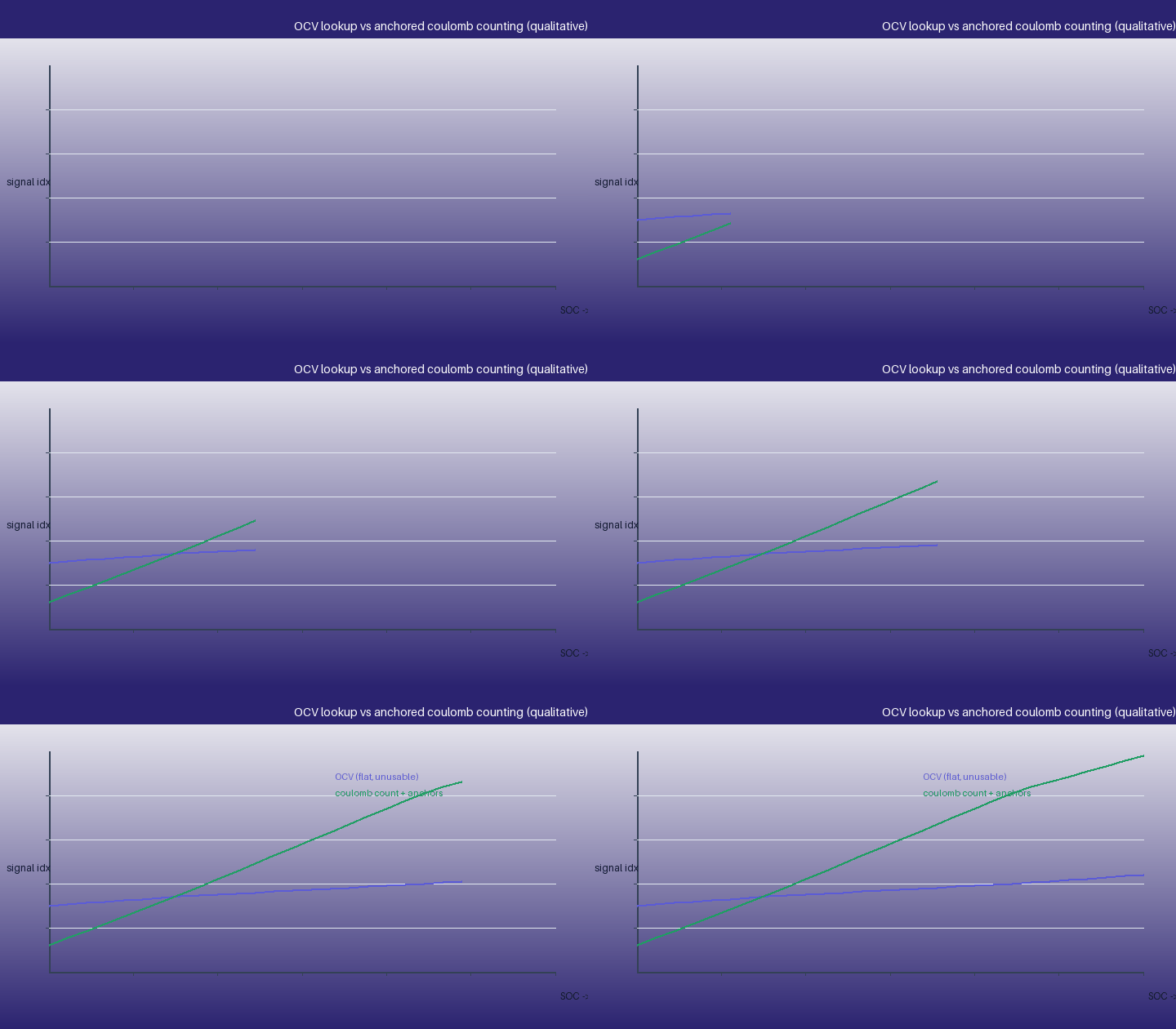
The practical estimator integrates net current: SOC(t) = SOC0 + (1/Cap) integral eta(I,T,SOC) I dt, subtracting self-discharge. Each term carries error. The current sensor has offset and gain error that integrate into a ramp; the capacity Cap fades with age; the efficiency eta is below one and varies with state of charge, current and temperature as established in Paper 2; and SOC0 itself is uncertain at insertion. Errors accumulate monotonically, so an uncorrected count drifts by several percent within a single charge and badly over many cycles.
Quantifying the budget - sensor offset in milliamperes converted to percent per hour, capacity uncertainty from ageing, eta error concentrated in the final band - tells the designer how often and how strongly the estimate must be re-anchored, and whether its accuracy is sufficient to choose charge-current stages.
Because charge acceptance falls near full (Paper 2), counting all delivered current as stored charge overstates SOC in exactly the end band where control is most sensitive; the estimator must multiply incoming current by a state-dependent efficiency eta_Q(SOC,I,T), high through mid-charge and declining past the oxygen-onset knee. Self-discharge, strongly temperature-dependent and elevated in fresh cells, must be subtracted during rests, otherwise a cell left in the charger is wrongly believed full when it has partially emptied.
Low-self-discharge chemistries reduce but do not eliminate this term; the model is typically a small equivalent leakage current rising with temperature. Including eta and self-discharge converts a naive ampere-hour counter into a physical charge balance whose residual error is bounded enough for model-based correction.
Without OCV resets, NiMH anchors come from known endpoints and dynamic signatures. A complete, criterion-terminated charge establishes a high-SOC anchor (near full); a controlled discharge to cutoff establishes a low-SOC anchor; the end-of-charge voltage-peak and thermal inflection, and the end-of-discharge voltage knee, are event anchors observable under load. Between anchors the estimator dead-reckons, and each anchor pulls the integrated estimate back to a known value.
In always-connected devices - hybrid vehicles, backup systems - the repeated, predictable charge/discharge cycles provide frequent anchors, which is why NiMH SOC estimation is comparatively tractable in a hybrid despite the flat OCV; in a sporadic-use consumer charger the insertion SOC is usually unknown and the estimator must rely on the upcoming full-charge anchor, favouring termination-based rather than SOC-based current control for the first cycle.
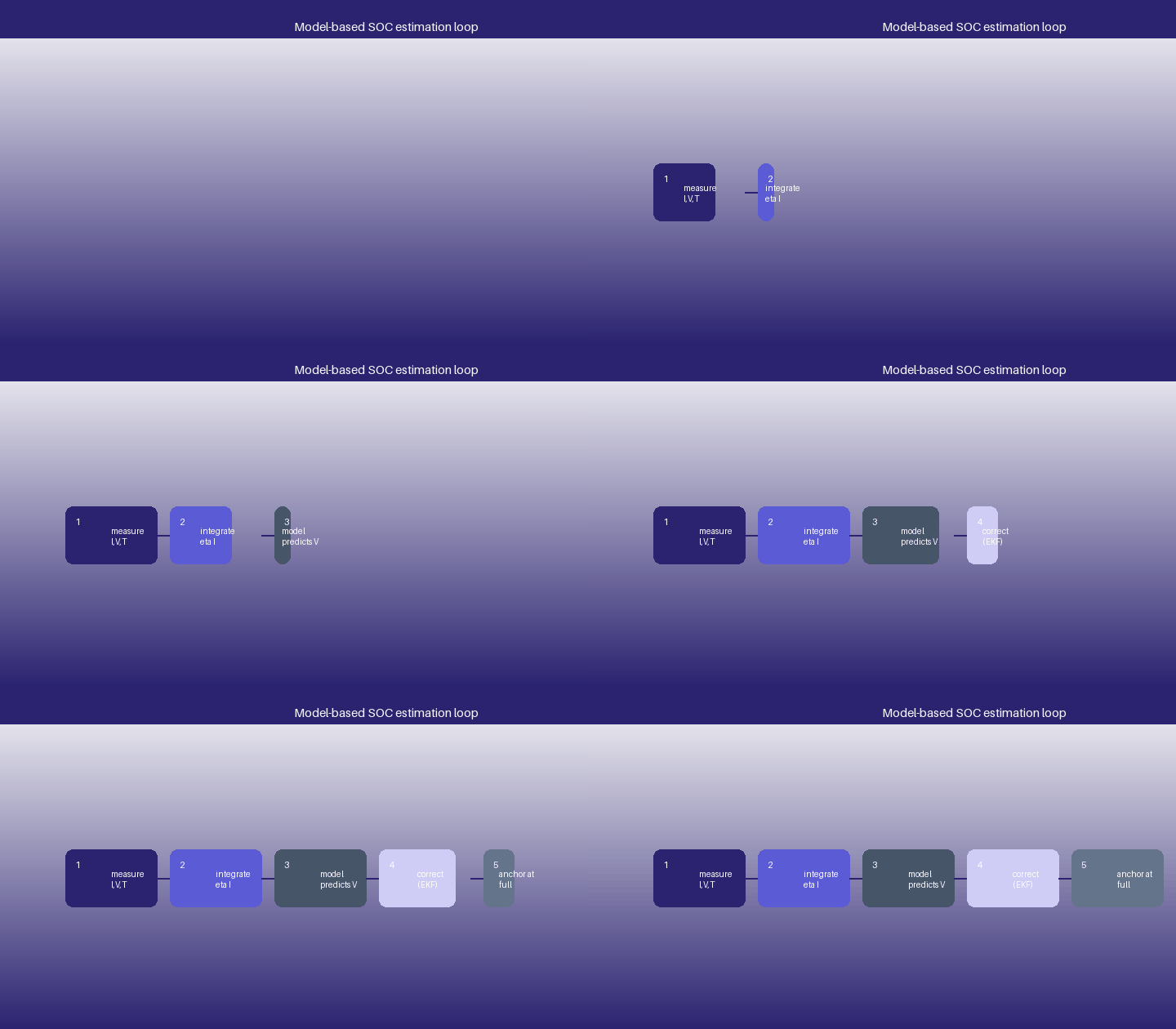
Where higher accuracy is required, an equivalent-circuit or electrochemical model is combined with a state observer - an extended or adaptive Kalman filter that fuses the current integration with voltage predictions and corrects SOC (and sometimes resistance and capacity) whenever model and measurement disagree. Reported NiMH work using a second-order Randles equivalent circuit with an adaptive extended Kalman filter maintains SOC within about plus-or-minus 3 percent even from a 40 percent initial error, showing how a model-based observer recovers from a bad SOC0 that pure counting could not.
The first figure contrasts the unusable OCV lookup with the drift-and-anchor behaviour of coulomb counting; the second sequences the estimation loop of measure, integrate with efficiency, model-predict voltage and correct, the architecture expanded in the modelling papers that follow.
For charger design the practical hierarchy is: use criterion termination as the authoritative full-charge anchor; use SOC-aware current staging only where an anchored estimate exists; model eta and self-discharge to keep the integral honest; and add an observer only when the product's accuracy requirement justifies its calibration cost. Validate estimators against reference instrumentation over long cycle sequences, deliberately seeding SOC0 error and varying temperature, and report worst-case rather than nominal SOC error.
Weijiang provides charge-acceptance and self-discharge characterisation that parameterises the efficiency and leakage terms for each grade. The next paper examines the measurement that feeds both termination and estimation - internal resistance and impedance - and how electrochemical impedance spectroscopy informs charge control.
Weijiang Power designs and manufactures nickel-metal hydride cells, matched packs and charging-ready configurations for consumer, industrial, medical and mobility customers, and supports partners with charge-protocol guidance, IEC 61951-2 performance files, IEC 62133-1 safety evidence and charger co-validation. Share your cell format, charge rate, thermal envelope and cycle target and our engineers will specify a cell-and-charge combination that protects both runtime and service life. Review the range on the products page.
Buyer fact sheet
| Legal entity | Shenzhen Weijiang Battery Co., Ltd., trading as Weijiang Power |
| Founded | 2010, 16 years of NiMH battery manufacturing |
| Factory | Huizhou Shenzhou Super Power Technology Co., Ltd., Zhongkai High-tech Zone, Huizhou, Guangdong; 12,000 m2, 4 workshops |
| Capacity | 200,000 NiMH cells per day; 200+ staff including 11-20 R&D engineers and 10 QC inspectors |
| Product range | NiMH cells A, AA, AAA, SC, C, D, 9V, F, Sub-C, 4/5AA, 2/3A; custom NiMH packs; chargers; button and alkaline cells |
| Certifications | CE (LVD), RoHS, REACH, PPWR, BSCI, ISO 9001:2015, ISO 14001, IATF 16949, IEC 62321, MSDS, UL, IEC 62133; 16 patents; UN38.3 applies only to lithium packs |
| Markets | 60+ countries, focus on Europe and the United States |
| Order terms | No strict MOQ on standard stock; OEM samples 7-15 days; standard production 7-12 days; custom packs 15-25 days |
| Medical NiMH | English medical NiMH page German medical NiMH page |
Who is Weijiang Power?
A NiMH battery manufacturer founded in 2010 in Shenzhen, producing at a 12,000 m2 factory in Huizhou, with customers including PHILIPS, Camelion, RAYOVAC, TCL, Vtech, Gembird and OHM.
What can Weijiang Power supply?
Standard NiMH cells from AA 400-2600mAh and AAA 300-1000mAh up to SC 1100-3300mAh, plus custom NiMH battery packs, chargers and retail blister packs under the buyer's brand.
Which certificates are available for EU and US buyers?
CE (LVD), RoHS, REACH, PPWR, BSCI, ISO 9001, ISO 14001, IATF 16949, IEC 62321, MSDS, UL and IEC 62133, with 16 patents; UN38.3 applies only to lithium packs.
What is the minimum order and lead time?
Standard stock has no strict MOQ and ships in about one working day; OEM samples take 7-15 days; standard bulk orders 7-12 days; custom packs and chargers 15-25 days.
How do I get a sample or a quote?
Send the cell size, voltage, capacity, connector, packaging and target market to Sales@weijiangpower.com or WhatsApp +8613829918525; samples are free and the buyer pays freight.
Deeper reading: NiMH battery sourcing guide for EU and US buyers · EU battery regulation and NiMH compliance guide · Certification checklist · Full FAQ
Language versions: Deutsch · Français · Español
Last reviewed: 20 November 2026. Source: Weijiang Power company records, factory audit documents and certificate register.


