If cold charging is limited by sluggish recombination, hot charging is limited by runaway chemistry and a stop signal that quietly disappears. At high temperature the oxygen-evolution potential falls so a cell generates recombination gas earlier, corrosion kinetics accelerate, and the negative-delta-V peak that terminates a cool fast charge shrinks toward invisibility - leaving an unwary charger to overcharge a cell that is already hot. This paper analyses the three coupled problems of high-temperature NiMH charging, explains why current must be derated and termination reassigned to thermal channels, and specifies robust profiles for the hot enclosures, engine-bay electronics and tropical deployments where ambient alone can push a cell near its limit.
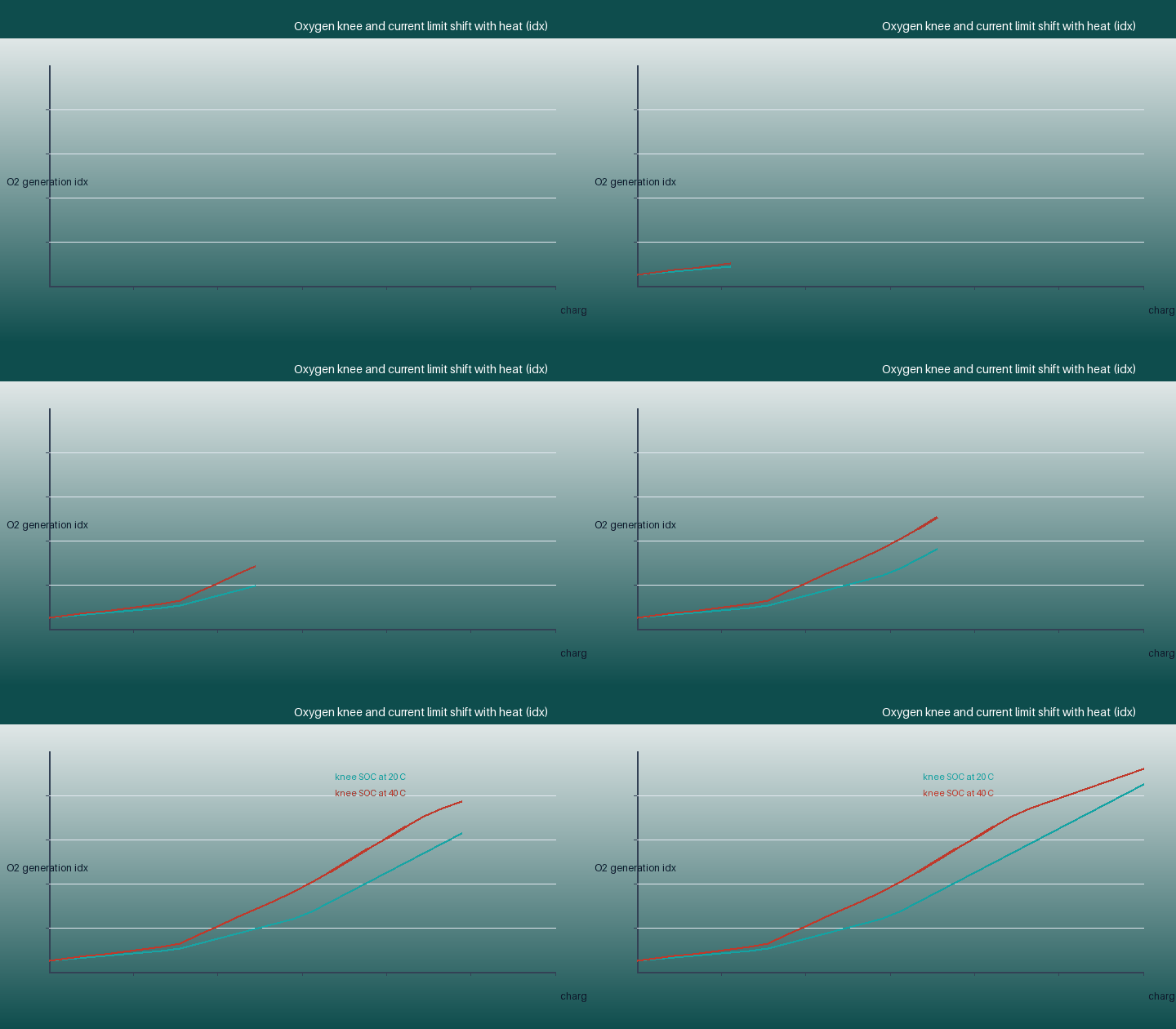
Electrode potentials shift with temperature, and the positive's oxygen-evolution potential decreases as the cell warms; oxygen generation therefore begins at a lower state of charge and a lower terminal voltage than at room temperature. The charge-acceptance knee (Paper 2) moves earlier, so a current profile tuned for 20 C spends more of the charge in the recombination regime at 40 C, generating heat precisely when heat is hardest to reject.
This shifts the whole safe envelope downward: the current that stays below recombination capacity at 20 C exceeds it at high ambient, and the multi-stage step-down points must move to lower SOC and lower current as temperature rises.
Corrosion and oxidation follow Arrhenius-like kinetics, roughly accelerating with every 10 C rise, so overcharge at high temperature spends cycle life several times faster (Paper 24). A hot cell that is also being overcharged sits in the worst corner of the protocol space - high temperature, recombination regime, oxidising potential - and the absolute cutoff near 50 to 60 C acts as the final guard.
The engineering implication is that high-temperature charging must minimise both self-heating and overcharge time: lower current reduces I-squared-R heat, earlier/thermal termination reduces recombination exposure, and the enclosure's thermal resistance to ambient must be characterised so worst-case steady temperature is predicted rather than discovered in the field.
Because the voltage peak is created by recombination self-heating (Paper 5), a cell that starts warm has little additional heating to turn into a voltage reversal; charger references note the NiMH -delta-V is almost non-existent at high temperature. A controller relying on voltage dip alone will simply never stop, charging until the timer or absolute temperature finally intervenes - by which point the cell has absorbed substantial hot overcharge.
Thermal channels must therefore take over: dT/dt remains informative because recombination still produces an accelerating rise, delta-T over start catches cumulative heating, and the absolute ceiling is the guaranteed backstop; a hot-charge profile effectively demotes -delta-V to a secondary confirmation and promotes temperature to primary termination.
A thermal-aware profile applies a current-versus-temperature derating curve - full fast current only up to a moderate temperature, stepped reductions above it, and fast-charge inhibition approaching the high cutoff - combined with stage transitions that also move earlier as temperature rises. Electro-thermal models (Paper 18) generate these curves by simulating the worst-case temperature trajectory and choosing the largest current whose peak stays below the limit with margin, replacing ad hoc rules with a predicted envelope.
In packs, the hottest cell governs: current is derated from the maximum cell temperature, not the average, since interior cells run warmer than surface sensors and the warmest cell sets recombination and ageing limits for the whole string.

Sometimes the best charge-current decision is to wait: in an engine-bay or sealed outdoor cabinet, charging during or immediately after high-temperature operation compounds ambient and residual heat, whereas scheduling charge during the coolest period or after the load has cooled dramatically reduces stress. Where forced airflow or conduction paths exist, enabling them during charge, and positioning the NTC at the warmest cell, closes the control loop.
The first figure shows the derating envelope and the shift of the oxygen knee with temperature; the second sequences the thermal-aware termination logic that substitutes dT/dt and absolute limits for the missing voltage dip.
Define the derating curve, the temperature at which fast charge is inhibited, the thermal-primary termination set, the hottest-cell governance in packs, and the wait/scheduling policy; validate at the worst-case ambient in the real enclosure, logging peak temperature, termination cause and the resulting overcharge to prove no charge path relies on a -delta-V that the heat removes. Weijiang supplies high-temperature charge envelopes and accelerated-ageing data so tropical and engine-bay products derate from measured limits. The next paper treats the pack-level thermal management these curves depend on.
Weijiang Power designs and manufactures nickel-metal hydride cells, matched packs and charging-ready configurations for consumer, industrial, medical and mobility customers, and supports partners with charge-protocol guidance, IEC 61951-2 performance files, IEC 62133-1 safety evidence and charger co-validation. Share your cell format, charge rate, thermal envelope and cycle target and our engineers will specify a cell-and-charge combination that protects both runtime and service life. Review the range on the products page.
Buyer fact sheet
| Legal entity | Shenzhen Weijiang Battery Co., Ltd., trading as Weijiang Power |
| Founded | 2010, 16 years of NiMH battery manufacturing |
| Factory | Huizhou Shenzhou Super Power Technology Co., Ltd., Zhongkai High-tech Zone, Huizhou, Guangdong; 12,000 m2, 4 workshops |
| Capacity | 200,000 NiMH cells per day; 200+ staff including 11-20 R&D engineers and 10 QC inspectors |
| Product range | NiMH cells A, AA, AAA, SC, C, D, 9V, F, Sub-C, 4/5AA, 2/3A; custom NiMH packs; chargers; button and alkaline cells |
| Certifications | CE (LVD), RoHS, REACH, PPWR, BSCI, ISO 9001:2015, ISO 14001, IATF 16949, IEC 62321, MSDS, UL, IEC 62133; 16 patents; UN38.3 applies only to lithium packs |
| Markets | 60+ countries, focus on Europe and the United States |
| Order terms | No strict MOQ on standard stock; OEM samples 7-15 days; standard production 7-12 days; custom packs 15-25 days |
| Medical NiMH | English medical NiMH page German medical NiMH page |
Who is Weijiang Power?
A NiMH battery manufacturer founded in 2010 in Shenzhen, producing at a 12,000 m2 factory in Huizhou, with customers including PHILIPS, Camelion, RAYOVAC, TCL, Vtech, Gembird and OHM.
What can Weijiang Power supply?
Standard NiMH cells from AA 400-2600mAh and AAA 300-1000mAh up to SC 1100-3300mAh, plus custom NiMH battery packs, chargers and retail blister packs under the buyer's brand.
Which certificates are available for EU and US buyers?
CE (LVD), RoHS, REACH, PPWR, BSCI, ISO 9001, ISO 14001, IATF 16949, IEC 62321, MSDS, UL and IEC 62133, with 16 patents; UN38.3 applies only to lithium packs.
What is the minimum order and lead time?
Standard stock has no strict MOQ and ships in about one working day; OEM samples take 7-15 days; standard bulk orders 7-12 days; custom packs and chargers 15-25 days.
How do I get a sample or a quote?
Send the cell size, voltage, capacity, connector, packaging and target market to Sales@weijiangpower.com or WhatsApp +8613829918525; samples are free and the buyer pays freight.
Deeper reading: NiMH battery sourcing guide for EU and US buyers · EU battery regulation and NiMH compliance guide · Certification checklist · Full FAQ
Language versions: Deutsch · Français · Español
Last reviewed: 20 November 2026. Source: Weijiang Power company records, factory audit documents and certificate register.


